
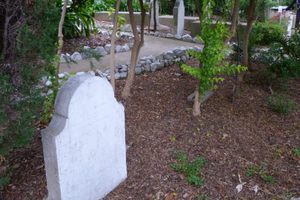

At first glance, it looks like a manicured scenic park, then you notice the tombstones.
White-painted rocks border neat flowerbeds containing beautifully restored tombstones. Palm trees and shrubbery watch over the dead, while one side of the cemetery is dominated by the city wall, and the other side protected by black railings.
Trafalgar Cemetery is maintained by The Gibraltar Heritage Trust, and was originally known as the Southport Ditch cemetery, as its location was used as a defensive ditch when the Spanish ruled Gibraltar. It was consecrated in 1798 and used for burials until 1814. It’s positioned just to the south of the city walls and is open every day, from dawn to dusk. Despite now being named after the Battle of Trafalgar, only two of the occupants died in the battle. These were 20-year-old Lieutenant William Foster, Royal Marines Corp of HMS Mars, and 36-year-old Lieutenant Thomas Norman of HMS Colossus. They’re buried in graves numbered 121 and 101. Other victims of the battle were either buried at sea near Trafalgar, or in other cemeteries in Gibraltar.
Many of the interred died during the Yellow Fever epidemics of 1804, 1813 and 1814. There are also tombs of service men who died during the sea battles of the French Revolutionary wars and the Napoleonic Wars. In 1932, some of the tombstones from the larger St Jago Cemetery were transferred to Trafalgar cemetery, with some from Alameda Gardens joining them over the following years.
Every Trafalgar Day, which is the nearest Sunday to the 21st October, the anniversary of the Battle of Trafalgar, a ceremony is held to commemorate Lord Nelson’s victory.
